
Why Regularization?
Standard least-squares fitting minimizes the error between model predictions and data. However, this can lead to problems:- Overfitting: The optimizer finds parameter values that match noise in the training data, leading to poor predictions on new data
- Ill-conditioning: When parameters are correlated (e.g., electrode thickness and diffusivity both affect time constants), small data perturbations cause large parameter swings
- Non-identifiability: Some parameters may not be uniquely determined by the available data
Ridge Regression
Ridge regression adds an L2 penalty (sum of squared parameter values) to the least-squares objective. This shrinks parameter estimates toward zero, reducing variance at the cost of introducing some bias.Problem Formulation
The ridge regression objective is: with residuals: where:- – vector of parameters to estimate
- – design matrix (model predictions as a function of parameters)
- – observed data
- – regularization strength
Normalization Requirement
For the L2 penalty to treat all parameters equally, both the residuals and parameters must be on comparable scales. This is typically achieved by Z-scoring (standardizing to zero mean and unit variance): Without normalization, parameters with larger natural scales would be penalized more heavily, distorting the regularization.Hyperparameter Optimization
The regularization strength is a hyperparameter that must be chosen carefully. Too little regularization leaves the model prone to overfitting; too much regularization forces parameters away from their data-driven values, introducing bias. The goal is to find the that best balances these competing effects.Bias-Variance Tradeoff
Regularization introduces a fundamental tradeoff between bias and variance:- Bias: Regularization shrinks parameters toward the prior, pulling estimates away from the “true” values. This is the cost of regularization.
- Variance: Without regularization, estimates are highly sensitive to noise in the training data. Regularization reduces this sensitivity.
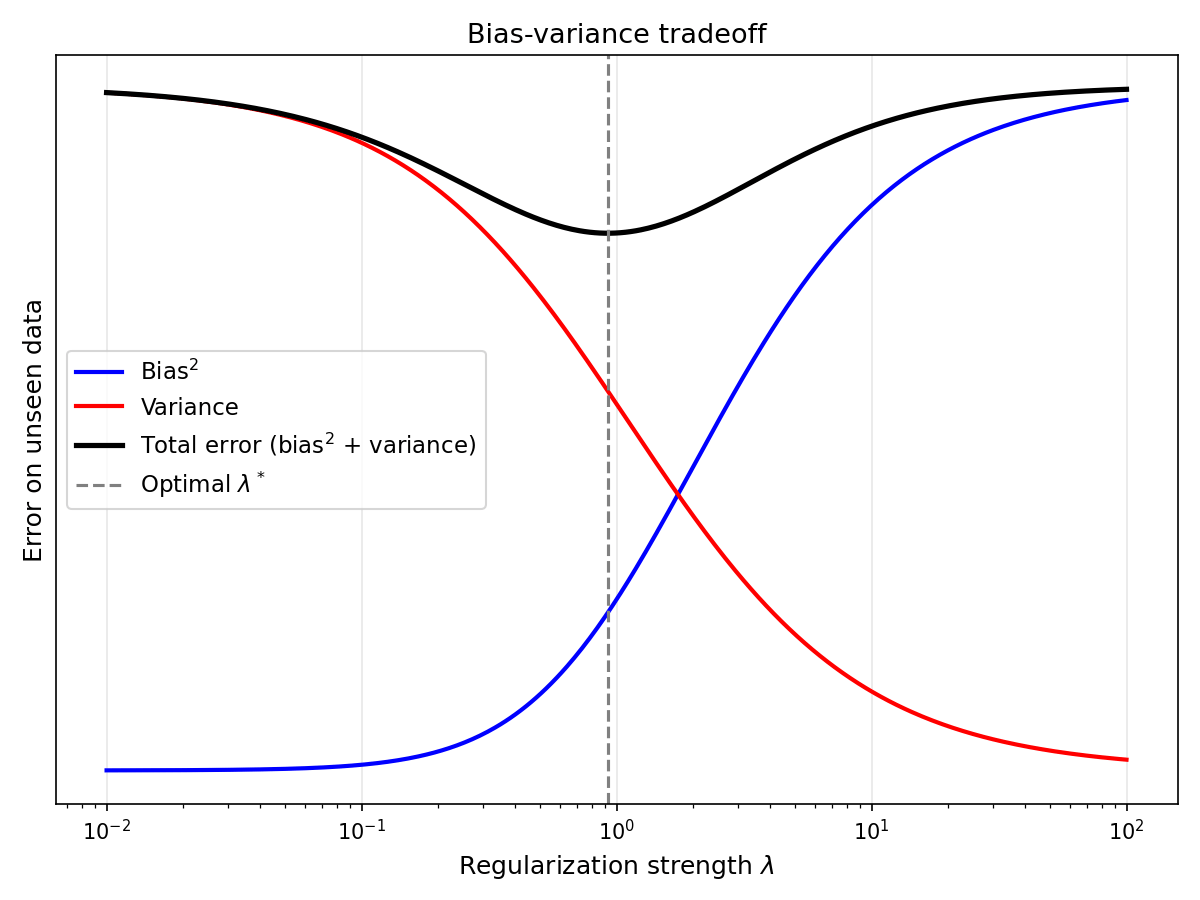
Bias-variance tradeoff as a function of regularization strength
Optimization Procedure
1
Fit on Training Data
For a fixed value of , determine using the training data
2
Evaluate Validation Error
Compute the prediction error on the validation set
3
Repeat for Multiple λ Values
Iterate steps 1-2 for several values
4
Select Optimal λ
Choose that minimizes validation error, then refit on combined training and validation data
Maximum A Posteriori (MAP) Estimation
While ridge regression shrinks parameters toward zero, we often have better prior knowledge—for example, literature values or physical constraints. MAP estimation with Gaussian priors generalizes ridge regression by shrinking parameters toward specified prior means rather than zero. From a Bayesian perspective, MAP estimation finds the parameter values that maximize the posterior probability given the data. With Gaussian priors and Gaussian measurement noise, this is equivalent to minimizing: where:- – model prediction at data point
- – observed data at point
- – measurement uncertainty (standard deviation)
- – prior mean for parameter (e.g., literature value)
- – prior uncertainty for parameter
Connection to Ridge Regression
MAP estimation is mathematically equivalent to ridge regression when parameters are centered at the prior mean and scaled by the prior standard deviation. Adding a regularization hyperparameter gives: When , this is standard MAP estimation. When , the data is weighted more heavily relative to the priors. When , the priors dominate.Efficient Nonlinear Regularization
For linear models, ridge regression has an analytic solution. Nonlinear models (like battery electrochemical models) require iterative optimization, and finding the optimal through cross-validation would require repeated refitting—computationally expensive. An efficient alternative leverages two key assumptions:- All parameters have priors: Every parameter has a specified prior distribution, eliminating identifiability issues where multiple parameter combinations give equivalent fits.
- Local quadratic approximation: Near the optimum , the objective function is approximately quadratic. This is valid when optimization has converged to a well-defined minimum.
Practical Usage
In practice, regularization is configured by attaching Gaussian priors to the parameters being fit. The prior mean represents your best estimate before seeing data, and the prior standard deviation encodes your uncertainty.To configure priors and run a regularized data fit, see Pipelines → Data Fitting → Regularization.
Choosing Priors
Good priors come from:- Literature values: Published measurements for similar materials
- Physical constraints: Known bounds from theory (e.g., diffusivity must be positive)
- Previous experiments: Results from related cells or conditions
- Order-of-magnitude estimates: Even rough estimates help stabilize fitting