> ## Documentation Index
> Fetch the complete documentation index at: https://docs.ionworks.com/llms.txt
> Use this file to discover all available pages before exploring further.
# Battery Capacity
> Nominal capacity, C-rate specific capacity, and usable capacity explained, with how each is measured in ampere-hours.
Battery capacity quantifies how much charge a battery can store and deliver—making it a critical metric for applications ranging from smartphones to electric vehicles. While the intuitive definition of capacity may seem straightforward, there are multiple ways to measure and report it.
## Types of Capacity
### Nominal Capacity
The most common definition of capacity is **nominal capacity**, the value typically provided by the battery's manufacturer. This is the amount of charge (measured in ampere-hours, Ah) the battery is designed to deliver under standardized test conditions.
Nominal capacity serves as a benchmark for comparing different batteries, but
it represents an idealized value—hence it's often reported as a round number.
Real-world conditions (temperature fluctuations, aging, faster discharge
rates) usually result in lower usable capacity.
### C-Rate Specific Capacity
The **C-rate** defines how quickly a battery is charged or discharged relative to its nominal capacity. A C-rate of 1C means the battery would be fully discharged in 1 hour; 2C means 30 minutes; C/2 (or 0.5C) means 2 hours.
The current corresponding to a given C-rate is:
$I = C\text{-rate} \times Q_{nom}$
For example, a 50 Ah battery at 2C draws $2 \times 50 = 100$ A.
| C-Rate | Discharge Time | Typical Application |
| ------ | -------------- | ---------------------------------- |
| C/20 | 20 hours | Capacity testing, characterization |
| C/3 | 3 hours | Standard capacity measurement |
| 1C | 1 hour | Typical EV discharge |
| 2C | 30 minutes | Fast discharge, high power |
### Measuring Capacity at a Specific C-Rate
To measure capacity at a given C-rate:
1. Fully charge the battery using the manufacturer's recommended protocol
2. Rest until voltage stabilizes (typically 1-4 hours)
3. Discharge at constant current corresponding to the desired C-rate
4. Stop when the lower voltage cutoff is reached
5. The capacity equals the integrated current over time
As the C-rate increases, kinetic and transport limitations become significant,
leading to lower measured capacities. Always report the C-rate alongside
capacity measurements to enable fair comparisons.
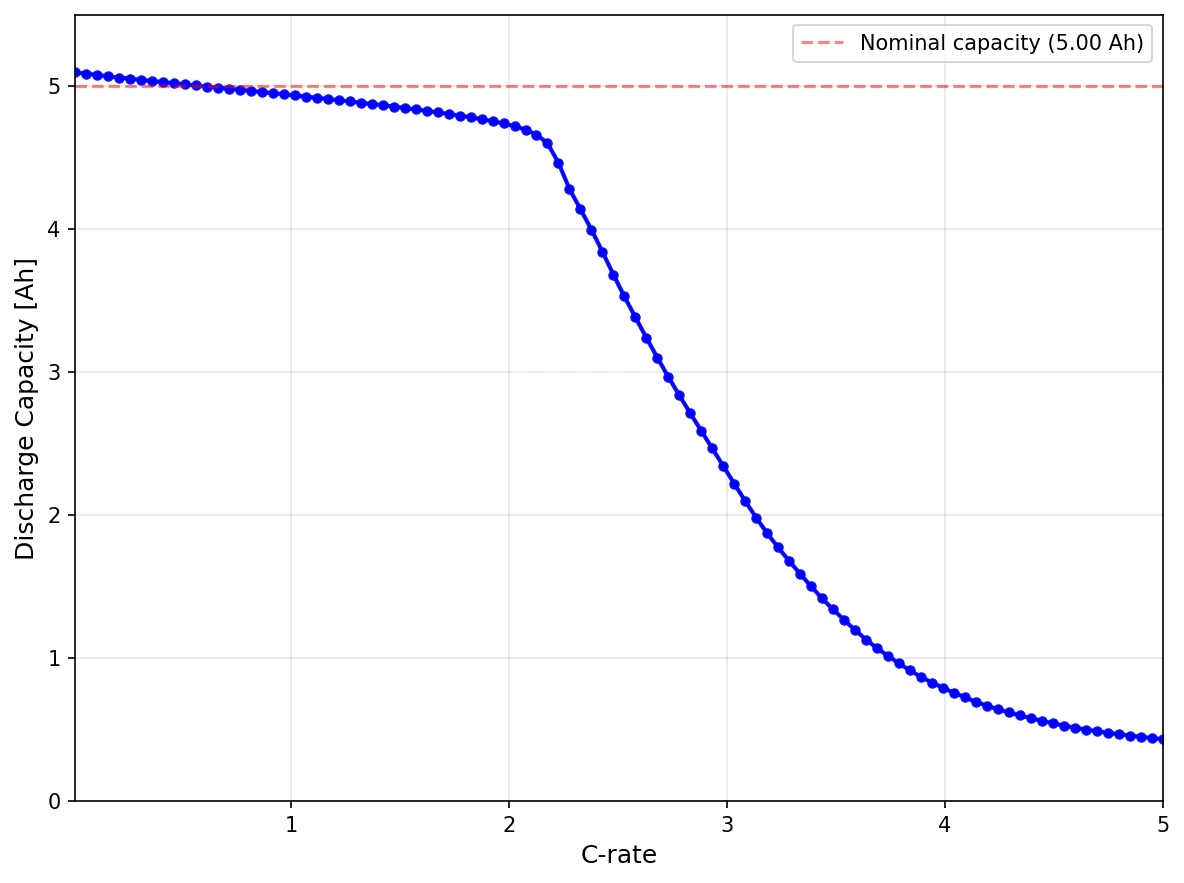 This definition is particularly important for assessing capacity fade due to degradation, where capacity is typically measured at a reference C-rate (commonly C/3 or C/5) to track changes over time.
### Theoretical Capacity
If we could discharge a battery infinitely slowly, we would obtain the theoretical (or thermodynamic) capacity. This is the maximum charge a battery can deliver within a given voltage window (e.g., 4.2 V to 2.5 V) when discharged infinitely slowly, eliminating all kinetic and transport limitations.
In practice, we cannot discharge a battery infinitely slowly, so we approximate the theoretical capacity by discharging at a very low C-rate. This will always result in an underestimation of the true theoretical capacity.
## Related Topics
* [State of Charge](/guide/batteries-101/state-of-charge)—measuring remaining charge relative to capacity
* [State of Health](/guide/batteries-101/state-of-health)—how capacity fades over time
* [Internal Resistance](/guide/batteries-101/internal-resistance)—why capacity decreases at high C-rates
* [Reaction Kinetics](/guide/batteries-101/reaction-kinetics)—the physics behind rate-dependent capacity loss
* [Degradation Overview](/guide/batteries-101/degradation)—mechanisms that cause capacity fade
This definition is particularly important for assessing capacity fade due to degradation, where capacity is typically measured at a reference C-rate (commonly C/3 or C/5) to track changes over time.
### Theoretical Capacity
If we could discharge a battery infinitely slowly, we would obtain the theoretical (or thermodynamic) capacity. This is the maximum charge a battery can deliver within a given voltage window (e.g., 4.2 V to 2.5 V) when discharged infinitely slowly, eliminating all kinetic and transport limitations.
In practice, we cannot discharge a battery infinitely slowly, so we approximate the theoretical capacity by discharging at a very low C-rate. This will always result in an underestimation of the true theoretical capacity.
## Related Topics
* [State of Charge](/guide/batteries-101/state-of-charge)—measuring remaining charge relative to capacity
* [State of Health](/guide/batteries-101/state-of-health)—how capacity fades over time
* [Internal Resistance](/guide/batteries-101/internal-resistance)—why capacity decreases at high C-rates
* [Reaction Kinetics](/guide/batteries-101/reaction-kinetics)—the physics behind rate-dependent capacity loss
* [Degradation Overview](/guide/batteries-101/degradation)—mechanisms that cause capacity fade